Introduction: The Invisible Revolution
Imagine waking up 50 years ago and trying to explain to someone that you carry the world’s knowledge in your pocket, that your car can drive itself, or that a computer can diagnose diseases faster than a doctor. They would call it magic. Today, we call it Artificial Intelligence (AI).
AI is no longer just a buzzword reserved for sci-fi movies or academic papers. It is the invisible backbone of modern life. From the Netflix recommendations that keep you glued to your screen to the fraud detection systems protecting your bank account, AI and Machine Learning (ML) are orchestrating a silent revolution.
But for many, these terms remain abstract. What exactly is the difference between AI and ML? How do machines “learn”? And more importantly, where is this all heading?
In this comprehensive guide, we will peel back the layers of this complex technology. We will move beyond the hype to understand the mechanics, the applications, and the ethical dilemmas of the AI age. Whether you are a business leader, a developer, or a curious observer, this post is your roadmap to understanding the most transformative technology of our time.
Part 1: Decoding the Jargon – AI vs. ML vs. Deep Learning
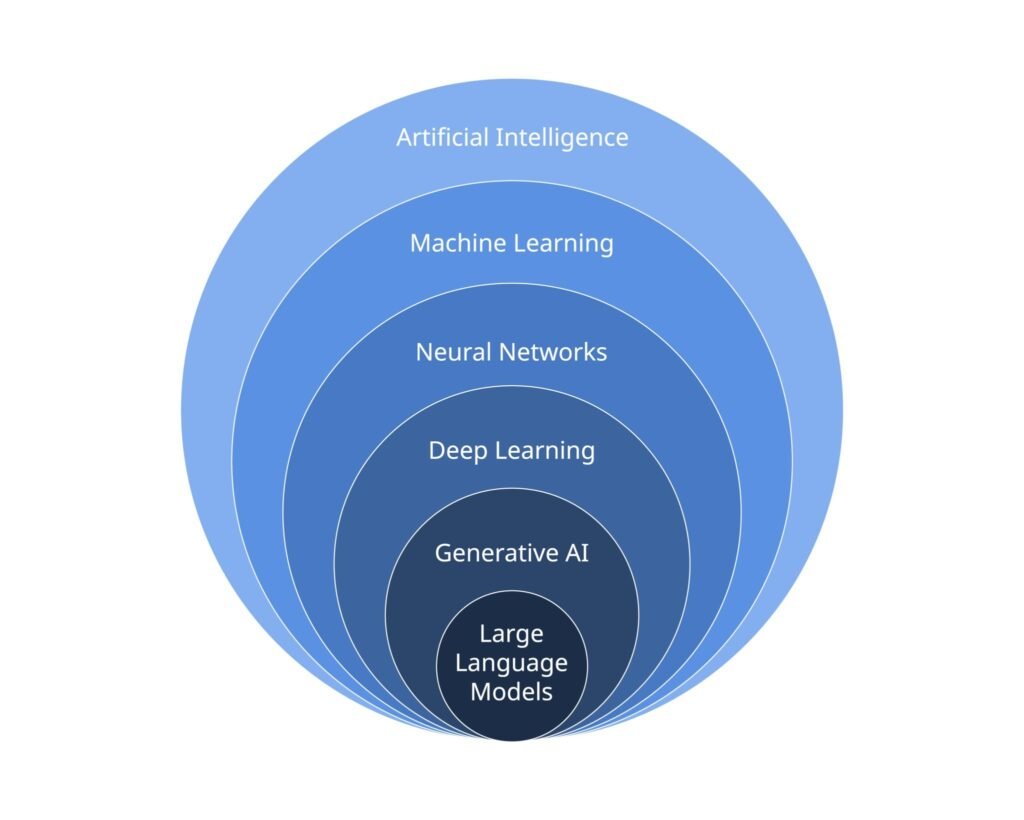
Before we dive into the mechanics, we must clear up a common confusion. You’ll often hear “AI” and “Machine Learning” used interchangeably, but they are not the same thing. Think of them as Russian nesting dolls.
Getty Images
1. Artificial Intelligence (The Big Picture)
AI is the broad umbrella term. It refers to any technique that enables computers to mimic human intelligence. This includes logic, if-then rules, and decision trees. Early AI (often called “Good Old-Fashioned AI”) was simply a computer following a strict set of programmed instructions to play chess or solve a maze. It was smart, but it couldn’t learn.
2. Machine Learning (The Sub-Field)
Machine Learning is a subset of AI. It is the science of getting computers to act without being explicitly programmed. Instead of writing code that says, “If the image has whiskers, it’s a cat,” we feed the computer thousands of images of cats and dogs. The machine analyzes the data, finds the patterns (whiskers, ear shape, nose texture), and builds its own rules. It learns from data.
3. Deep Learning (The Engine)
Deep Learning is a specialized subset of ML inspired by the human brain. It uses multi-layered structures called Artificial Neural Networks. While standard ML might need a human to tell it which features to look for (e.g., “look for round edges”), Deep Learning figures out the features itself. It is the technology behind self-driving cars and advanced language models like GPT.
Key Takeaway: All Deep Learning is Machine Learning, and all Machine Learning is AI. But not all AI is Machine Learning.
Part 2: Under the Hood – How Do Machines Actually Learn?
To understand the power of AI, you have to understand the “how.” Machine Learning isn’t magic; it’s math. Specifically, it relies on three primary types of learning.
1. Supervised Learning: The Teacher and the Student
This is the most common form of ML today. Imagine you are teaching a child the alphabet. You show them a flashcard with the letter “A” and tell them, “This is A.” You repeat this until they get it right.
In Supervised Learning, the algorithm is trained on a labeled dataset. It knows the input (an image of a tumor) and the correct output (benign or malignant). The algorithm makes a guess, compares it to the correct answer, and adjusts its internal math to reduce the error.
- Use Cases: Spam filters (Email is labeled “Spam” or “Not Spam”), Credit scoring, Image recognition.
2. Unsupervised Learning: Finding the Hidden Structure
What if you gave the child a pile of photos and said nothing? Eventually, they might sort them into piles: “These are people,” “These are landscapes,” “These are animals.” They found patterns without guidance.
Unsupervised Learning deals with unlabeled data. The AI explores the data to find hidden structures or clusters. It’s like a digital detective looking for anomalies or groupings that humans might miss.
- Use Cases: Customer segmentation in marketing (grouping similar buying habits), Anomaly detection in cybersecurity.
3. Reinforcement Learning: The Carrot and the Stick
This is how you train a dog. If it sits, it gets a treat (positive reward). If it jumps on the couch, it gets a scolding (negative penalty).
In Reinforcement Learning (RL), an agent learns to make decisions by performing actions in an environment and receiving feedback. It tries, fails, learns, and tries again, optimizing for the maximum long-term reward. This is the closest ML gets to “learning by experience.”
- Use Cases: Robots learning to walk, AlphaGo playing board games, Stock market trading algorithms.
Part 3: The Engine of Modern AI – Neural Networks
If you want to understand why AI has exploded in the last decade, you have to look at Neural Networks.
Shutterstock
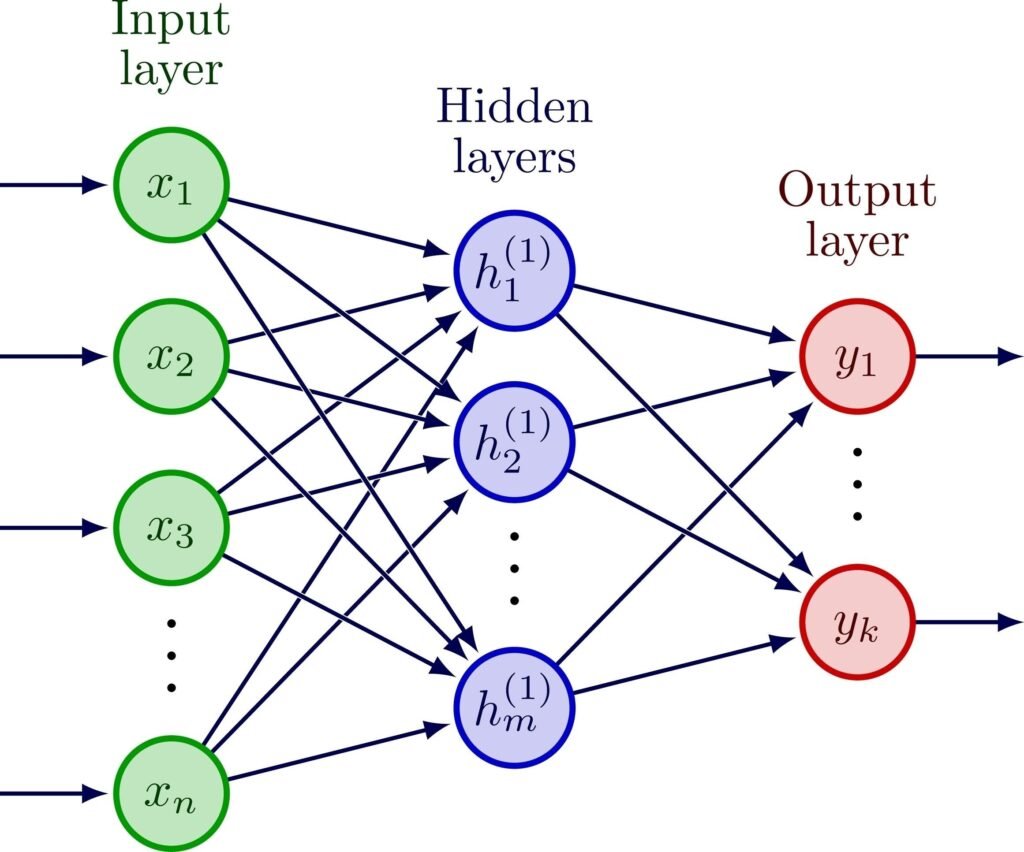
A Neural Network mimics the neuronal structure of the human brain. It consists of layers of nodes (neurons):
- Input Layer: Receives the raw data (pixels of an image).
- Hidden Layers: The magic happens here. Dozens or even hundreds of layers process the information, extracting increasingly complex features. The first layer might recognize edges; the next, shapes; the next, eyes and noses; and the final layer, a face.
- Output Layer: Delivers the final prediction (“This is a photo of a Golden Retriever: 98% confidence”).
The “Deep” in Deep Learning refers to the depth of these hidden layers. The more layers, the more complex patterns the network can recognize. This requires massive amounts of computing power (GPUs) and vast datasets, both of which became widely available only in the last decade.
Part 4: AI in the Wild – Real-World Applications
We are moving past the theoretical. AI is reshaping industries in real-time. Here is how it is being deployed today.
Healthcare: The AI Doctor
AI is saving lives by predicting diseases before symptoms appear.
- Radiology: AI algorithms can scan X-rays and MRIs to detect early signs of lung cancer or breast cancer with greater accuracy than human radiologists.
- Drug Discovery: Developing a new drug usually takes a decade. AI can simulate molecular interactions to identify promising drug candidates in months, drastically cutting costs and time.
Finance: The Algorithmic Banker
Money moves at the speed of light, and AI is the traffic controller.
- Fraud Detection: By analyzing millions of transactions per second, ML models can flag suspicious activity (like a credit card used in two different countries within an hour) instantly.
- Algorithmic Trading: High-frequency trading bots use AI to analyze market trends and news sentiment to execute trades in milliseconds.
Transportation: The Autonomous Future
Self-driving cars are the poster child of AI, utilizing computer vision and sensor fusion to navigate complex environments. But it’s not just cars; AI optimizes logistics, predicting the exact route a delivery truck should take to save fuel and time, revolutionizing supply chains.
The Creative Arts: Generative AI
This is the new frontier. Tools like ChatGPT, Midjourney, and DALL-E utilize Generative AI. Instead of just analyzing data, these models create new data. They write poetry, generate photorealistic images, and compose music. This is blurring the line between human and machine creativity, forcing us to redefine what it means to be an “artist.”
Part 5: The Elephant in the Room – Challenges and Ethics
With great power comes great responsibility. The rapid ascent of AI has raised critical ethical questions that we cannot ignore.
1. The Black Box Problem
Deep Learning models are often described as “black boxes.” We know the input and we see the output, but the internal decision-making process is so complex that even the engineers who built it cannot fully explain why the AI made a specific decision. In healthcare or criminal justice, “The computer said so” is not an acceptable justification. We need Explainable AI (XAI).
2. Algorithmic Bias
AI is only as good as the data it is fed. If you train a hiring algorithm on resumes from the last 10 years, and those resumes were mostly from men, the AI will learn that “men are better candidates.” It will penalize resumes from women. We have seen facial recognition systems that struggle to identify people of color because the training data was predominantly white. mitigating bias is one of the biggest hurdles in ML today.
3. Job Displacement
The automation anxiety is real. While AI creates new jobs (AI ethicists, prompt engineers, data scientists), it inevitably renders others obsolete. Routine, repetitive tasks—whether blue-collar manufacturing or white-collar data entry—are at risk. The challenge for society is not stopping AI, but managing the transition and upskilling the workforce.
Part 6: The Road Ahead – What’s Next for AI?
We are currently in the era of Narrow AI (ANI). Our machines are brilliant at specific tasks (playing chess, translating languages), but they lack general understanding.
The Holy Grail is Artificial General Intelligence (AGI)—a machine that possesses the ability to understand, learn, and apply knowledge across a wide variety of tasks, indistinguishable from a human. While experts disagree on when (or if) we will reach AGI, the immediate future holds exciting developments:
- Edge AI: Moving AI processing from the cloud to your device (phone, watch, car) for faster, more private operation.
- AI-Human Collaboration: The future isn’t AI replacing humans; it’s AI augmenting humans. Surgeons using AI-assisted robots, designers using AI for brainstorming, and writers using AI for research.
Click Here To Apply for Computing Support Analyst Job in the UK 2026 | Science and Technology Facilities Council (STFC)
Conclusion: Embracing the Machine Age
Artificial Intelligence is not a fleeting trend; it is a fundamental shift in how we interact with information and the world around us. It offers the potential to solve humanity’s most intractable problems, from curing diseases to reversing climate change through energy optimization.
However, the path forward requires vigilance. We must demand transparency, fight against bias, and ensure that the benefits of AI are distributed equitably.
The machines are learning. The question is: Are we ready to learn with them?
If you are a business owner, now is the time to ask how AI can streamline your operations. If you are a student, now is the time to learn the basics of data literacy. The future belongs to those who understand the language of algorithms.